01SAME RESPONSE · TWO CACHES
How do max-age and s-maxage differ?
max-age sets an explicit freshness lifetime. For a shared cache, s-maxage takes priority over it and Expires. A private cache ignores s-maxage. RFC 9111 §5.2.2.10 ↗
Cache-Control: public, max-age=60, s-maxage=300
FreshTrace example · Age starts at 0 · 75 seconds after receipt
PRIVATE / BROWSER60s lifetimeStale · contact origin
SHARED / CDN300s lifetimeFresh · 225s remaining
In the model, a shared response with s-maxage also needs validation once stale. The cache labels describe roles; deployment configuration can change real behavior.
02RECEIPT IS NOT A RESET
Why does max-age=60 leave only 15 seconds?
The Age header represents time already spent since generation or validation. FreshTrace adds time since receipt; with capture clocks, it also accounts for apparent age and response delay. RFC 9111 §4.2.3 ↗
Cache-Control: max-age=60
Age: 45
45sAlready old
+15sAfter receipt
=60sCurrent age · stale
This example assumes zero transit delay and apparent age, as the lab does without capture timestamps. At receipt, 15 seconds remain. At elapsed 15, the response reaches its freshness boundary. FreshTrace considers current age < lifetime fresh. Capture defaults and boundaries ↗
03TWO DIFFERENT PERMISSIONS
Does no-cache mean “do not store”?
Unqualified no-cache requires successful validation before reuse. It can permit storage. no-store forbids storing the response for reuse. Storage and reuse are separate decisions. RFC 9111 §5.2.2.4 · §5.2.2.5 ↗
Validate before reuse
Cache-Control: no-cache, max-age=600
ETag: "version-1"
At age 10, FreshTrace allows storage but requires origin validation. The nominal 600-second lifetime does not bypass no-cache.
Do not store
Cache-Control: no-store
At age 10, FreshTrace blocks storage. The next request needs a network fetch; there is no stored response to reuse in this scenario.
Qualified field directives and successful 304 updates are outside this example. The lab models one unchanged stored response, not a sequence of refreshes.
04FRESHNESS ENDS · PERMISSION MAY CONTINUE
When can a stale response still be served?
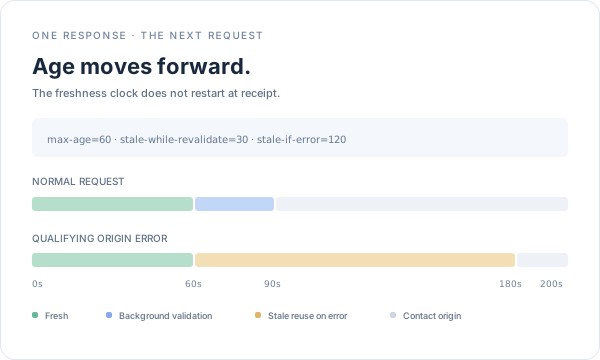
stale-while-revalidate permits stale reuse while validation runs in the background. stale-if-error permits stale reuse during a qualifying origin failure. Their allowances are measured from the freshness boundary. Support and use depend on the cache implementation. RFC 5861 §§3–4 ↗
Cache-Control: max-age=60, stale-while-revalidate=30,
               stale-if-error=120
FreshTrace example · Age starts at 0 · a matching stored response| Current age | Normal request | Qualifying origin error |
|---|
| 75s | Background validation | Stale reuse on error |
|---|
| 120s | Contact origin | Stale reuse on error |
|---|
| 181s | Contact origin | Origin required · cannot reuse |
|---|
In FreshTrace, SWR ends at age 90 (exclusive); SIE ends at age 180 (inclusive). The engine conservatively blocks stale allowances under no-cache, must-revalidate and, for shared caches, proxy-revalidate or s-maxage. A visible window never guarantees a cache hit. Model choices ↗
 FreshTrace